Moving Beyond the Transfer: The Drawdown Phase
Completing your QROPS transfer is a massive milestone—your UK pension capital is now safely in India. However, the work does not stop there. The true value of your transfer is realized in the drawdown phase. How you withdraw, invest, and manage those funds will determine your actual lifestyle comfort during retirement in India.
To maximize your retirement income, you must coordinate three critical variables: **tax efficiency**, **portfolio growth**, and **currency safety**.
1. Tax-Efficient Drawdown Structuring
In India, withdrawals from a QROPS are generally taxed as salary income at your applicable income tax slab rates. If you withdraw unstructured lump sums, you risk pushing yourself into the highest 30% tax bracket. Instead, consider these structures:
- The One-Third Rule. Under traditional Indian QROPS structures, you can withdraw up to one-third of the transferred corpus completely tax-free at retirement as a tax-free lump sum.
- Systematic Withdrawal Plans (SWPs). For the remaining two-thirds, instead of taking large taxable lump sums, utilize systematic withdrawals designed to spread the tax liability evenly over several financial years.
- Slab Management. Coordinate your pension withdrawals with other Indian income streams (e.g., rental income or fixed deposit interest) to ensure your total income stays within a lower tax bracket.
Double Taxation and the DTAA
Always ensure your scheme administrator applies the UK-India Double Taxation Avoidance Agreement (DTAA). This guarantees that UK tax is not deducted at source on your pension withdrawals, allowing you to settle tax purely in India.
2. Managing the Inflation Drag in India
While the UK retirement market deals with low single-digit inflation, returning NRIs must plan for a structural inflation rate in India typically averaging 4% to 6%. A static annuity that pays the exact same rupee amount year after year will lose half its purchasing power within twelve years.
To combat this, your QROPS portfolio must contain growth assets. Allocating a portion of your funds to diversified equity mutual funds, blue-chip shares, or hybrid instruments ensures your capital grows faster than inflation, preserving your lifestyle standard.
3. Hedging and Capitalizing on the Exchange Rate
If you transfer your pension to a standard domestic rupee-denominated QROPS, your exchange rate is locked at the date of transfer. If you prefer to capture currency fluctuations, utilizing a GIFT City IFSC QROPS allows you to hold your assets in GBP and convert to INR incrementally during periods of rupee weakness, capturing a natural conversion premium.
Structure Your Income
Get a Custom Retirement Roadmap
Our financial planners will model a tax-efficient withdrawal strategy tailored specifically to your retirement lifestyle budget.
The Golden Rule of Retirement Wealth
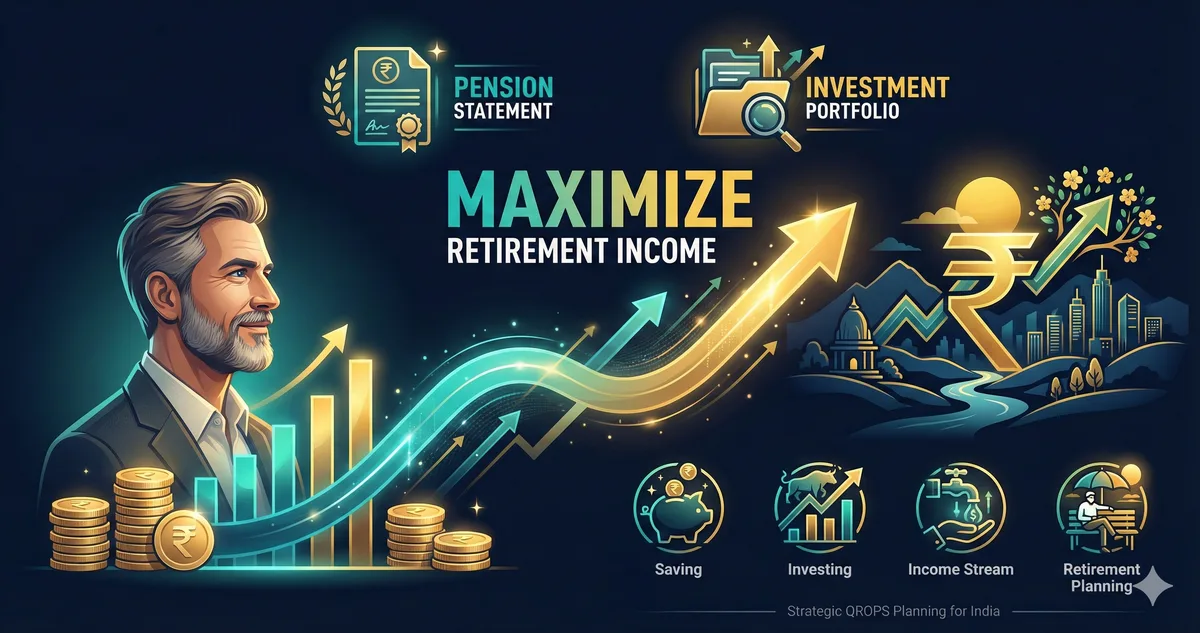
Never treat your pension as a static pot of cash. By implementing active tax planning, ensuring growth-focused asset allocation, and managing currency exchange strategically, you can secure a growing, predictable income stream that easily supports your retirement dreams back home in India.