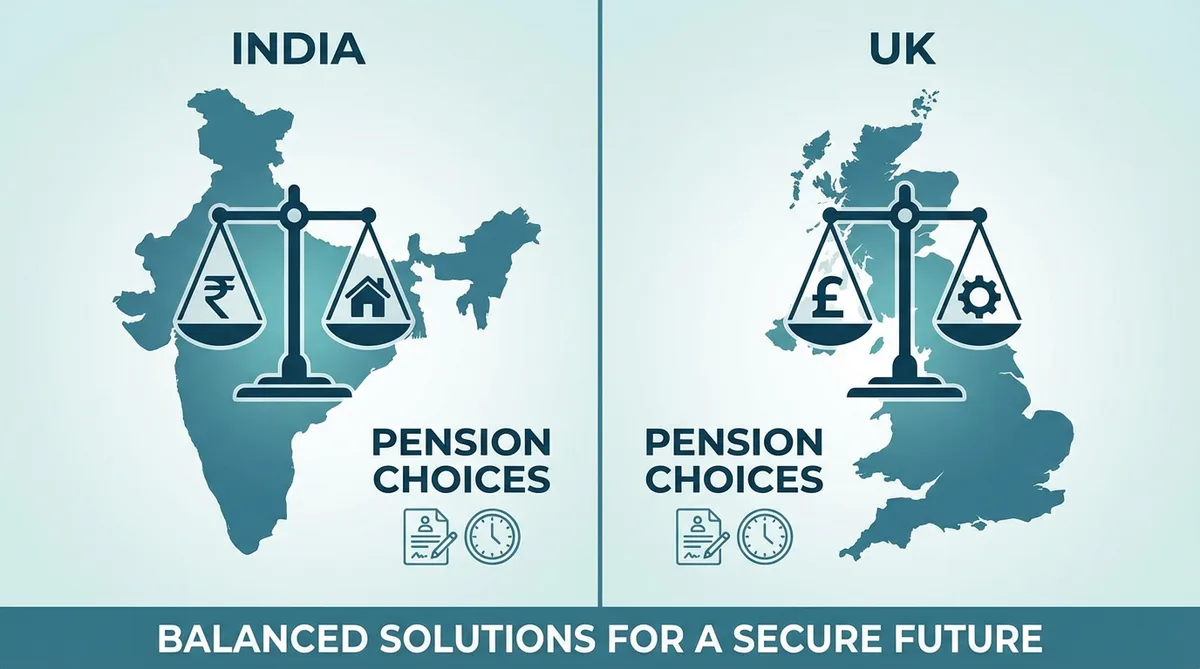

Two Completely Different Animals
In the UK pension landscape, not all retirement pots are created equal. When planning a QROPS transfer to India, you must first identify which of the two primary pension categories you hold: Defined Benefit (DB) or Defined Contribution (DC).
Transferring a DC pension is highly straightforward and administrative in nature. In contrast, transferring a DB pension represents a major, life-altering financial transaction that triggers strict UK legal mandates, including mandatory advice thresholds. Let us examine how the two options stack up.
1. Defined Contribution (DC) Pensions: The Flexi-Pots
Also known as "money purchase" schemes, Defined Contribution pensions are standard individual investment accounts (such as personal pensions, SIPPs, or corporate group personal plans). Your pension value is simply the cash value of the underlying assets (shares, bonds, mutual funds) held in your account.
- The Transfer Logic. You sell the underlying mutual funds, convert the portfolio to GBP cash, and transfer the capital directly to your Indian QROPS scheme.
- No Advice Mandate. HMRC and the UK FCA do not legally require you to obtain formal financial advice to transfer a DC pension, regardless of the value (though it remains highly recommended for high-value pots).
- Drawdown Freedom. Once in India, the funds continue to accumulate inside your QROPS portfolio, and you can draw systematic payments under local rules.
2. Defined Benefit (DB) Pensions: The Final Salary Promises
Often referred to as "final salary" or "career average" schemes, DB pensions are traditional corporate retirement plans. They do not hold a pot of cash in your name. Instead, they represent a binding legal promise from your former employer to pay you a guaranteed, inflation-linked income for life, starting from your scheme retirement age.
To transfer a DB pension, the scheme trustees must calculate a Cash Equivalent Transfer Value (CETV)— a lump-sum capital figure representing the present value of giving up that lifetime guaranteed income promise.
The £30,000 Legal Advice Threshold
Under UK law (Section 48 of the Pension Schemes Act 2015), if your DB pension has a Cash Equivalent Transfer Value (CETV) exceeding **£30,000**, you are legally barred from transferring the funds until you have obtained formal, written advice from an FCA-regulated pension specialist. The trustees will reject your transfer paperwork instantly if a signed advisor sign-off is missing.
Key Comparison: DB vs. DC Transfers
| Feature / Dimension | Defined Contribution (DC) | Defined Benefit (DB) |
|---|---|---|
| Underlying Asset | A physical pot of cash / investments. | A legal promise of lifetime income. |
| Mandatory UK Legal Advice | No legal requirement (any value). | Legally required if CETV exceeds £30,000. |
| Risk Profile | You carry the investment and inflation risk. | The employer / scheme trustees carry all risk. |
| Timelines | Fast-track (typical 4 to 8 weeks). | Complex (typical 12 to 20 weeks). |
| Transfer Value (CETV) Sensitivity | Highly stable (linked to asset values). | Extremely volatile (linked to gilt yields & interest rates). |
Why DB Transfers are Highly Regulated
When you transfer a Defined Benefit pension, you are giving up a guaranteed, risk-free, inflation-proof monthly income for life, along with spouse death benefits. If you move this capital to a QROPS and the investment markets crash, or you draw down too quickly, you risk running out of money in retirement.
This is why the UK Financial Conduct Authority (FCA) enforces a strict starting assumption that *a DB transfer is not suitable for most clients*, unless special circumstances (such as cross-border relocation, severe health issues, or estate legacy objectives) justify the trade-off.
Model Your DB vs. DC Position
Request a DB Feasibility Review
Our specialists will analyze your UK pension statement, verify if it is a DB or DC scheme, and outline the exact advice and compliance steps needed to transfer safely.
Making an Informed Choice
For Defined Contribution savers, a QROPS transfer is a natural, low-friction way to align your retirement savings with your new life in India. For Defined Benefit holders, a transfer represents a complex trade-off between guaranteed security and estate planning flexibility. Work with experienced, cross-border specialists to stress-test your pension type and ensure your strategy passes every regulatory hurdle.